

Salem can be understood most quickly as a continent that resembles 16th Century Europe. The main theme of Salem is extreme religious fervour. The church is in charge and defines what is acceptable; anyone different is burned as a witch or warlock.
The colour of Salem is White, signifying Magic, Air and Imbuing.
Click here to read Recent Developments
Table of contents

Salem has a varied climate and geography similar to that of Europe, the middle east and the steppes. The main Salem land mass has a temperate climate, with the extreme north being a frozen land and the south being a warmer Mediterranean-type climate. Technically a part of Salem, the southeastern most region is known as Araby. The climate of Araby is very dry and warm, but not the bone-dry deserts and rare oasis of Dust. Flood plains and rivers nourish and irrigate Araby, making it a very fertile and prosperous region.

To understand Salem you need to understand a people who, for their own protection, have been oppressed and kept in the dark for many hundreds of years. Following decades of upheaval and war, Salem has been left fractured and unstable, and its once Shard-spanning Holy Empire reduced to a patchwork of competing realms. The Holy Empire of Salem, often called the Western Empire, though diminished, remains one of the strongest realms under the Emperor, but its Duchies hold significant sway. To the east, a militarised People’s Republic suppresses its population under the iron grip of the Commissioner General.
The Papal States act as a uniting force in Faith, where the Church rules the land directly, and its doctrine is enforced across all lands where the Church holds sway. Even the People’s Republic of East Salem, where Religion is weaker, fear of reprisals from the Church (especially the Inquisition) ensures they at least make a show of adherence. In the north, the Teutonic Order impose an even harsher religious orthodoxy with inquisitorial zeal. Other territories diverge sharply; Araby flourishes through knowledge and elemental pacts, Moldavia survives on fragile coexistence with werewolves, and Latveria remains an isolationist but tolerant enclave. New kingdoms like Achaea and the now free lands of Carinthia struggle for legitimacy amid competing claims, while the White Hand’s undead-controlled Aragon stands as a dark reminder of the Monsters that await within the lands.
Beyond the Teutonic Lands in the extreme North are the lands of the outcasts, where the Witches and Warlocks were driven, the Saami as they are known form faerie alliances, the Khinghan roam the steppes with their own faith and brutal customs, and the Attacotti of Avalon remain unconquered and mysterious.
With the Church fractured between moderates and hardliners, a succession crisis in the papacy, and tensions mounting between traditional nobility, military states, and merchant powers, Salem teeters on the brink of continent-wide conflict.

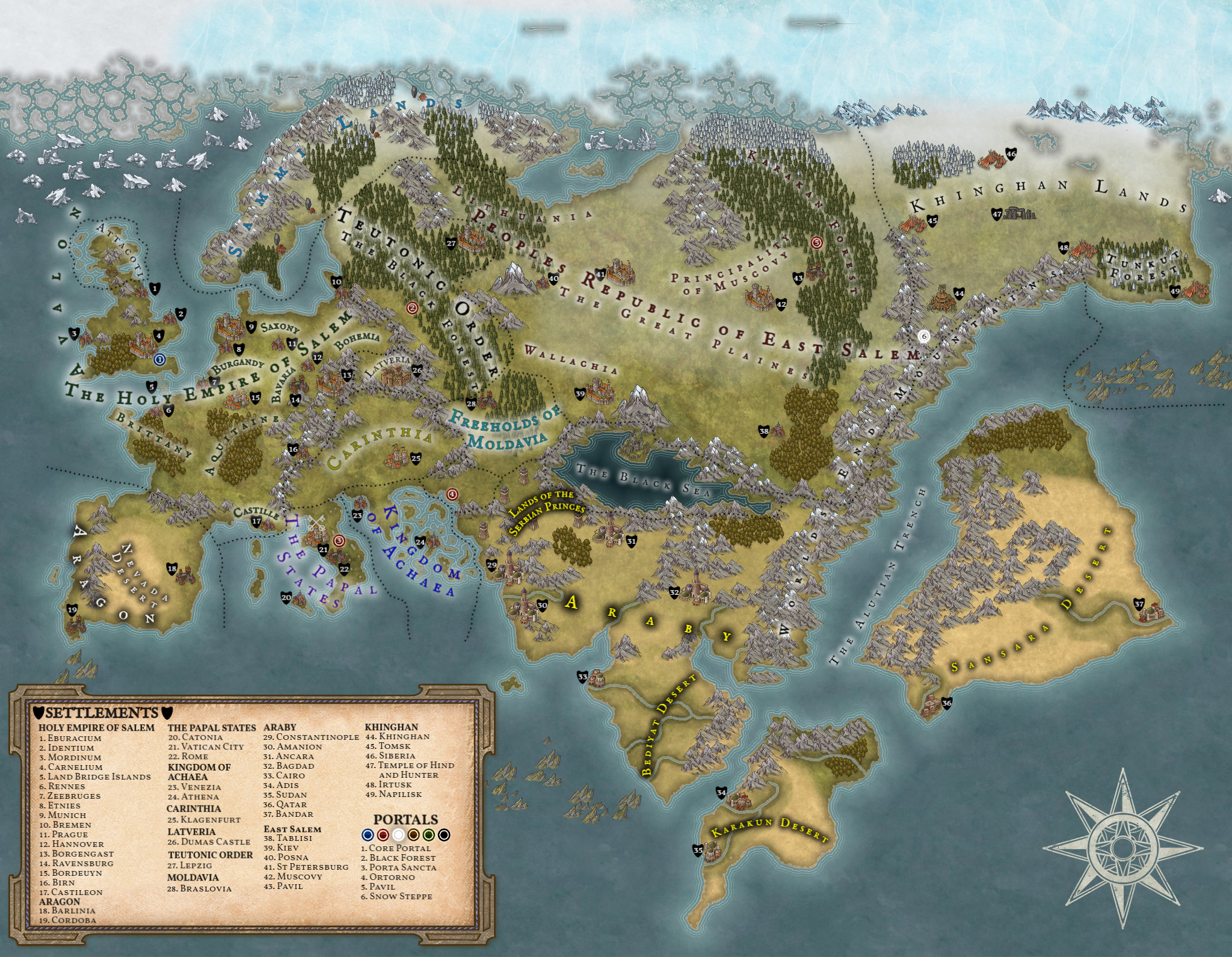
Once dominated by the Vast Holy Empire of Salem, the land is now divided into many Nations, including the Holy Empire, Eastern Salem, the Papal States, Teutonic Lands, Araby, Moldavia, Achaea, Aragon, the Attacotti lands, Latveria, Saami lands, Khinghan, and Carinthia.
The Holy Empire
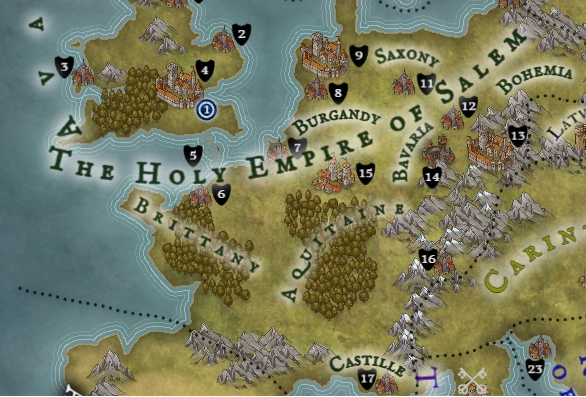
What remains of the great Empire, diminished now but still a powerful Nation within Salem, it is ruled by an Emperor and split into Duchies that follow the Emperor’s rule. These Duchies are: Aquitaine, Avalon, Bavaria, Bohemia, Brittany, Burgundy, Castille and Saxony. The land is very religious but not as fanatical as some. It will tolerate foreigners, even fey and those that use magic; but they are not popular, encouraged to stay away from those that live here, and magic is best done quietly out of sight.
Avalon is worthy of note: once connected to the main continent by a land bridge that was destroyed at the culmination of the Demon War, it is now home to many of the Forsaken, and the Duchess of Avalon is the Forsaken Queen. The capital is Carnelium and on the banks of its main river is the core portal for Salem. This grants Carnelium an importance in Salem it may have struggled to realise otherwise.
The Duchy of Aragon was claimed by the White Hand during the Demon War, so its leaders are in exile.
Religious variance
The Church has a strong influence here.
While they follow the Church in all matters internally, the people are more open to outsiders and do not actively punish them as Witches, Abominations and Heretics. There is still much mistrust however, and overt displays of deviances are not tolerated. Likewise contact with natives is discouraged and seeking to influence them can result in severe punishment. Punishments at their most extreme are more likely to result in deportation than burning.
Notable people
- Emperor Steiner – Ruler of Western Salem.
- Queen Morticia – Leader of the Free Forsaken and Duchess of Avalon.
- Sir Kalin Ortorno Istel – Consort of Queen Morticia, Knight Champion of Faerie.
- Azryal – Son of Morticia and Kailen.
- Duke Lorencz Molleris of Bavaria
- Duke of Saxony – Forsaken leader of Saxony
- Duchess of Burgandy
- Duke and Duchess of Aquitain
- Duke of Castille
- Duke or Duchess of Brittany
- Duke or Duchess of Aragon – In exile
- Duke of Bohemia
- Seraphin Wrexler – Influential figure in West Salem
Peoples Republic of East Salem
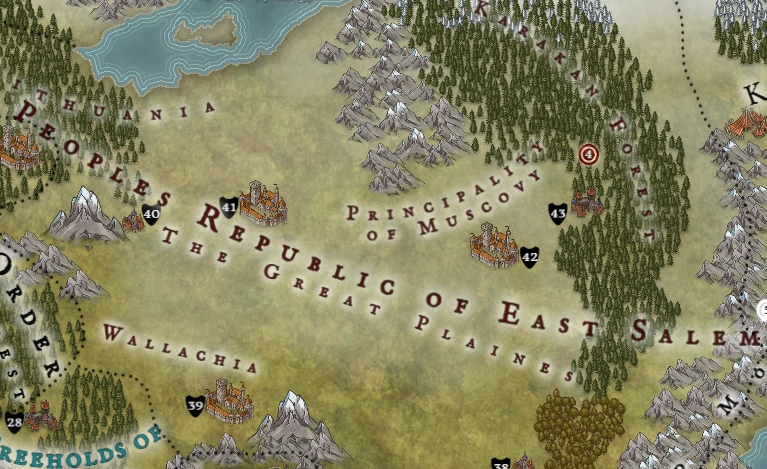
East Salem was once vast but has been whittled away by war, disaster and treaty. It is still a large area but not as dominant as it once was. The richer lands that lay closer to the West are independent, and the remaining areas are sparsely populated, plagued by long winters and rocky grounds that are hard to farm.
It is ruled by the Military, under the autocratic command of the Commissioner General. People are oppressed, and free thought and free movement is not allowed. They follow the teaching of the Wissen to the letter, reading books is only allowed under licence where it is for the good of the nation. Everyone is conscripted into the military for three years as they reach maturity, some remain, but most are assigned an occupation and whether you like it or not you do it – or you get flogged, jailed or worse.
Like West Salem it will nominally tolerate foreigners, even fey and those that use magic, but they are not popular and magic is best done quietly out of sight. Any foreigner, however, is considered probably a spy or up to no good, so may find themselves followed, interrogated and mostly excluded.
Religious variance
The Church has moderate influence here.
They allow the Church to exist and preach to the masses, but there is a clear distinction between the rulers and Church, and the Rulers are in charge.
Notable people
- Commissioner General Melenkov – Leader of East Salem.
- General Anotoly Balaki – Diplomat for East Salem.
- General Byrd – a General based in St Petersburg
The Papal States
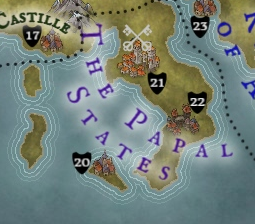
Seat of the Church and, for now at least, the centre of Unity on Salem. The Supreme Pontiff holds great power over all those that follow the teachings of the Wissen, and resides in the Vatican within Vatican City. Gatherings of the various religious peoples of Salem bring the Church together as one.
The Inquisition are nominally based here, though the hard-line elements left for the Teutonic Lands some years ago. They pursue the enemies in the shadows across Salem.
Unlike in older days when the Church and the Empire of Salem was one, the Church remains independent of the Western Empire. For Faith in God is more important than the squabbles of nobles, and Unity comes from One Faith and One God, brought together, in One Place.
Following the death of the most recent Supreme Pontiff, several Anti-Popes have risen in lands across Salem. While the religion is united here, and the Curia still meet in the Vatican, there is no Supreme Pontiff to lead them.
Religious Variance
The Church has total control here.
Church Law pervades and they rule directly over the masses. Outsiders are tolerated to a point if they are helping, but anyone who violates the law or tries to subvert the people will be executed.
Notable people
- Cardinal Edwin Salzburg – Cardinal of the Black Forest Region, a traditionalist but known to be reasonable and willing to open Church membership. Having been exposed to the corruption of the Church from within by Constantine, he is concerned with the sanctity and unity of the organisation. One of the Three Anti-Popes – he has been declared Supreme Pontiff with the backing of the Teutonic Order, as well as some of the Curia and many lay-members of the Church. Currently, he has the largest support (if not enough) of the three contenders.
- Cardinal Thoresby – Cardinal of Avalon, one of the Three Anti-Pope’s.
- Cardinal Masovia – Cardinal of Wallachia, one of the Three Anti-Pope’s.
Lands of the Teutonic Order
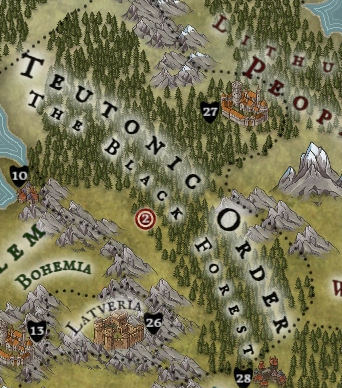
The Teutonic Lands cover much of the far north, a great area once called the Black Forest. The people follow the rule of the Teutonic Knights with the Grand Master at the head. The Religious Police at their side are led by the Magister who in turn controls the Military Inquisition led by the Inquisitor General. The population has taken on the old ways: anyone that looks different, foreigners, followers of a different religion etc, should tread very carefully and remain hidden.
For ruling titles see the Church Knight Titles in the Church of the One True God section.
Religious Variance
The Church has very strong influence here.
Almost the same as the Papal States, they follow the One Faith in its absolute: Church Law is the highest Law. The Laws and the Commandments of the Church are enforced with an iron hand by the Inquisition Office. Transgressors should expect no clemency, with sinners hunted down, tortured and publicly hanged or burned as a deterrent to others. There are no exceptions.
Notable people
- Grand Master Albrekt Von Salzer – Leader of the Teutonic Order.
Araby
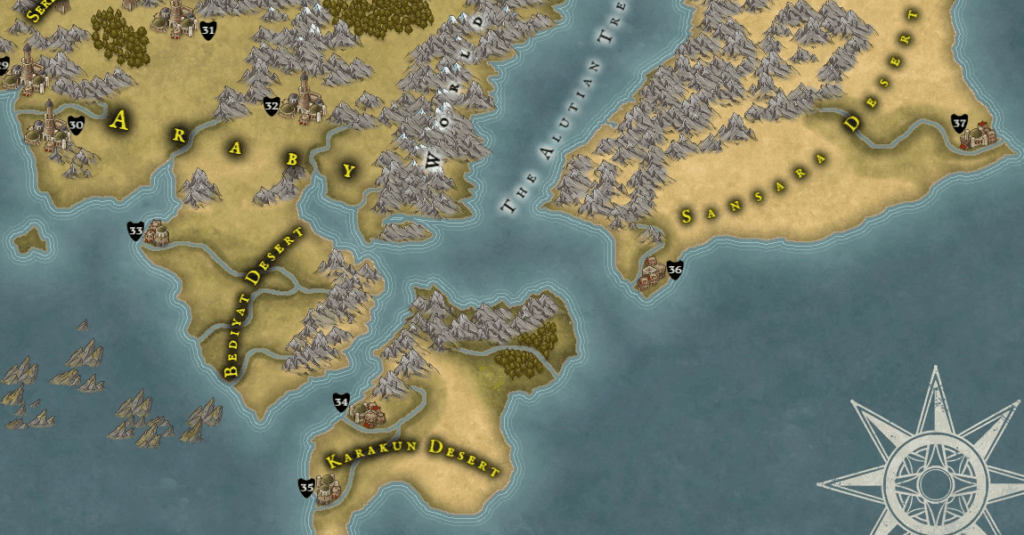
To the far southeast is Araby, a land that follows the teachings of the Wissen in a very different way to the rest of Salem.
A nation hungry for knowledge, a place which celebrates its libraries likes cathedrals in the west, books are prized and given attention. However, cut off for many centuries by armies of Salem they lack great swathes of knowledge and have developed their own ways of thinking.
One of the greatest wonders in Araby is the way they treat elementals. Elementals power much of their technology and do so willingly under strict contractual agreements as to their treatment and reward; some elementals even follow the religion of the One True God. Such is the skill of Araby’s theurgical engineers that they have been able to create idols that act like storage vessels for the faith of their congregation and keep evil at bay.
The land of Araby is ruled by many Princes and Princesses, with no single head of governance. This creates a dysfunctional chaos as each Prince or Princess believes their way is correct for the future of the land. This leaves the peoples and advisers below running around trying to make the chaos work and ensure no one Prince or Princess gets left out.
Since the Serbian Princes joined their lands into Araby, the chaos has become much worse. Only time will tell if this book-loving nation will find a Prince strong enough to lead them, or if they will be forever an ungoverned directionless mess where laws can change by the hour or by whichever Prince is present at the time.
Religious Variance
The Church has minimal influence here.
The people of Araby take quite a liberal approach to the One True God and have no laws banning magic or reading; they believe God placed these tools in their hands for the benefit of all and they should be used. Elementals, also called Djinn, are also a part of God’s Design and many of them share the Faith. They have no Cardinals or any of the hierarchy of the Church of the rest of Salem, indeed it is unclear if they even recognise the authority of the Supreme Pontiff. Priests come where they are needed, and each Prince has their own Royal Priest, who tends to matters of the faith for their Court. The theurgical engineers hold a unique position, they are like the monks of the Western Church, but hold a much higher respect.
Notable people
- Prince Iosef Al Albert Araf Sheimann – Prince of Araby, Envoy.
- Crown Prince Amir – ‘Leader’ of Araby
- Fisal – Priest to the Crown Prince
- Prince Hitesh Valji – Youngest Brother of Crown Prince Amir.
- Prince Ademetus – One of Serbian Princes.
- Prince Has-rat
- Prince Jamarl
- Princess Anisha
Freeholds of Moldavia
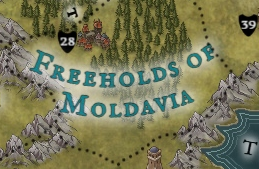
A series of large walled towns, surrounded by smaller villages nestled amidst large sprawling forests and wild lands. Here the places of civilisation are the bastions of humanity. But the wilderness belongs to the many and varied packs of werewolves that roam the wild places, since they were driven from the Black Forest by the Teutonics.
In the North the grey werewolves work with the peoples of the towns and villages, and seek to make a stronger peoples from their two races. Here they are closer to their ancestral lands, and the werewolf tribes are calmer due to the proximity to the Faerie flower that calms their rage in the Black Forest.
In the South, the wild lands are dominated by the brown werewolves, who keep away from settlements and have been known to prey on those that step too far from the roads. The people know not to go out at night, for although the brown werewolves are staunch defenders of Moldavia, they rarely can tell friend from foe when in their battle rage. Further from their ancestral lands the werewolf tribes here are more prone to frenzy and rage.
Religious Variance
The Church has moderate influence here.
Though the Werewolves do not revere a God that hates their existence, the human peoples of Moldavia do follow the teachings of the Wissen – however, their approach is somewhat more pragmatic. They know the werewolves are abominations in the eyes of God, but the priests of this land teach that even abominations can serve God’s will. So, abominations are tolerated as long as they serve God’s will.
Notable people
- The Alpha – Leader of the Werewolf Nation, a brown werewolf.
The Kingdom of Achaea
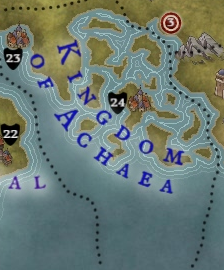
For years the merchant houses built a potent trading empire across Salem and across other Shards. As the Thule Brotherhood weakened, resources were needed, and so taxation increased. The merchant houses of Achaea sensed the time had come to wrest power from the Thules.
Funding of mercenaries to support the growing resistance began and finally, in February AU 27, the Thules were driven out. However, the leader of the resistance, Otto of Bohemia, declared himself King in their place.
In the time since, Otto has established a tenuous rule from Athena. However, while Otto’s rebels are loyal to him, many of the common folk view him as an outsider. Meanwhile, the Doge of Venezia, leader of the merchant houses, wants to turn Achaea into an oligarchic merchant republic, with himself ruling as the Grand Doge. Conflict is inevitable in this unstable land.
Religious Variance
The Church has strong influence here.
Having only recently broken from the Thules, who outlawed all religion, the priests are only now returning to this land, but are being embraced by the new King who seeks legitimacy from the Church.
Notable people
- King Otto – King of Achaea, formerly a Mercenary, Otto of Bohemia. Fought in the Demon War, joined the growing resistance against the Thule Brotherhood, eventually becoming its leader. After the resistance overthrew the Thules, and with a fanatically loyal militia, he decided to take control of Achaea as its new King.
- Chancellor Sotirakis – Chief Advisor to the King, deals with the day-to-day running of the Kingdom.
- Doge Stefanos Isauros – A merchant Prince, Doge of Venezia, the nominal head of the merchant houses.
Aragon (White Hand Lands)
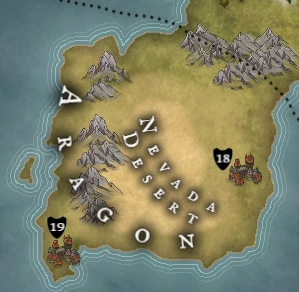
The Duchy of Aragon, once part of West Salem, has been taken over by the White Hand, and the dead guard its borders.
The White Hand have consolidated their power and are shaping their plans for the future.
Religious Variance
The Church has no influence here.
There is no religion here that is practised openly – if any living people remain here at all.
Attacotti Lands
Latveria
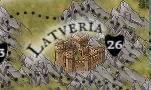
In the midst of Salem lies a land called Latveria, ruled by man called Victor von Dumas. It is often an island of calm in whatever storm besets Salem, although its borders are normally shut.
Heavily protected by its geography, its people and by Lord von Dumas himself, Latveria remains a free-thinking oasis for religion and those considered different.
Religious Variance
The Church has minimal influence here.
One of the few regions outside of Araby that does not have a Cardinal, the people of Latveria follow the teachings of the Wissen – however, there is much debate about the teachings in keeping with the true intentions of God, as well as debate over the correct edition of the Wissen, for some suspect the hand of the enemies of Salem have influenced it over the years.
Notable people
- Victor von Dumas – Ruler of Latveria and master of technology.
Saami Lands
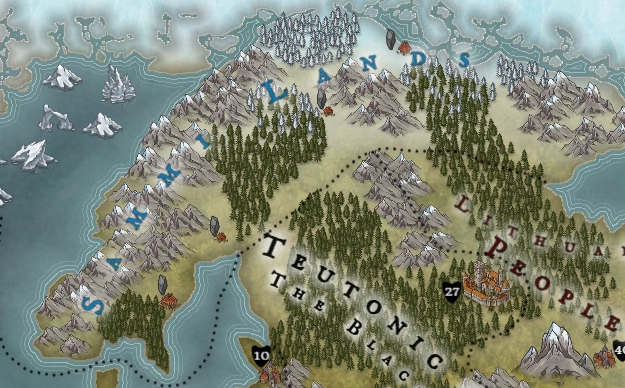
To the very North-West of the Salem continent lies the Saami lands, cut off from the rest of Salem by dense forests (filled, some say, with gaseous swamps and the webs of giant spiders), razor-sharp mountains and unclimbable coastal cliffs. Rumours have it that these isolated lands are populated by evil witches and warlocks who curse all who reach its borders, eight foot tall white haired apes that could tear a man in half and dreaded lindwyrms. Or so the Salemite rulers would have us believe since nobody travels there, but perhaps they are right?
Recently, they have signed a treaty with the Fae Courts, though what this entails is not fully understood.
Religious Variance
The cult of the Great Spider holds sway here – the One True Faith has no hold.
Khinghan
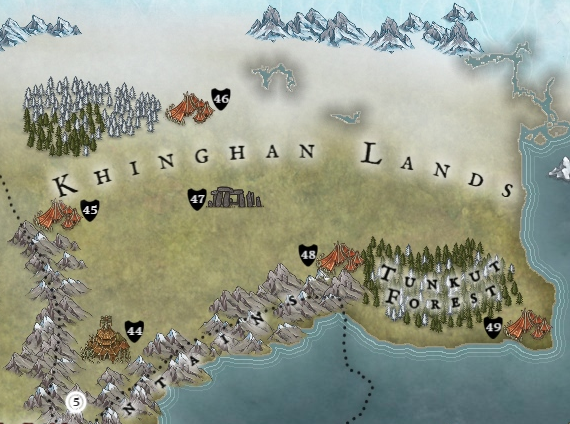
The Khinghan (or Khingan) are nomadic herders (similar to the Cossacks, Huns and Mongols of Earth) in the far North-East, well beyond the western mountains of eastern Salem.
They live in small family groups following their herds of giant elk and reindeer. They travel the steppe between the hidden farm shrines of the White Hind where they gift some of their herd to the shrine guardians who pass on the bounty of the Hind in the form of fruit and vegetables. The Huntsman has no shrines, but during each hunt the heart of the prey is eaten raw in the Hind’s honour.
Khingan family groups are quite small, 2 or 3 families who are usually closely related, but in times of danger they will meet up with their extended family, calling the clan together to face the threat. Larger threats see the gathering of the horde which then sweeps across the steppe leaving death and destruction behind it.
They have 3 main tribes or clans: the Irtusk clan is the biggest, rich in food and horses; the Tomsk clan, who guard against the border, are raiders; and finally the Siberian clan, who are very tough, dress for extreme cold, ride reindeer and have access to rich minerals. These are not the only clans.
One thing to note about the Khingan is that they never lie – it is against their religion. Rather than lie, they will say nothing and walk away Players should always choose this flaw if they play a Khingan character.
In conversation, the Khingan will generally provide one- or two-word answers. They are blunt, say what they mean and even what they think in a way that may seem rude to outsiders. They don’t make ‘small talk’.
Religious Variance
The Church has no influence here.
The Huntsman and the White Hind is the dominant religion, though Missionaries of the One True Faith try to convert these wayward peoples.
Notable people
- Anatole Dubois – Bishop working as part of Khinghan Tribes
- Balamber – Shaman of the Huntsman
- Altantsetseg – Shaman of the White Hind
Carinthia
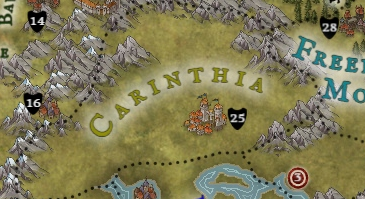
Newly liberated from the Thule Brotherhood, the fate of this land is yet to be decided. The Holy Empire has the greatest claim, as this land has historically belonged to the West, yet East Salem shed much blood for it in the purge of the Thules and desires a more fertile land to add to their realm. Yet others believe it should be given to the Church, while some wish for it to be able to chart its own destiny like Moldavia and Achaea.
The future of this land has yet to be decided.
Religious Variance
The Church has very strong influence here.
With no other governing authority, and with it bordering the Papal States, the Church has undisputed authority in Carinthia.
Other groups, organisations and individuals
- Luca Raven – Leader of the Raven Family, missing since the fall of the Thule Brotherhood.
- Saberhagens – A Vampire, one of the Thirteen.
- Brethren of Minuo – A group of experimental scientists, known to be working with multiple sources.
- Beggar’s Roost – A organisation that looks after the persecuted in Salem
- The Cabal – The Cabal is a worldwide crime syndicate that includes the Triads of Archipelago, The Knights of Discord & Misrule, The Crimson Brotherhood and the Sable Veil among others. In Salem they are just known as the Cabal.

By far the most prominent religion in Salem is belief in the One True God, followed by all but the Khingan and Saami.
People believe in the One True God whether they are from West Salem, Latveria or even Araby. They do, however, often follow and interpret ‘the One True God’s wishes’ in many different ways.
Most of the Khinghan believe in The Huntsman and the White Hind. From what is known, the White Hind is the lady of the hearth and herd, while the Huntsman is her husband and lord of the hunt and warfare.
In the far North, The Great Spider is worshipped by the Saami people. Players cannot pick this as their religion but may be aware of it.
Church of the One True God
To fully understand Salem it is important to fully understand the role of the Church. To educated, free people the Church of Salem may be viewed as a vast theocracy, a few chosen to rule the majority using fear as a tool. However the truth is the Church has taken on a great and difficult task. Salem developed from a society of survivors, and to continue surviving requires discipline and protection for its people. By the very nature of the threats against Salem only the Church, in the name of their God, is able to do this.
Their methods may appear harsh, but when the very Shard itself is soaked in the powers of dark forces that twist the unwary against their kin, a strong hand is needed to protect and group its people. From the fear that the White Hand will kill and raise all the people of this land, to the Vampires that stalk the night; the Werewolves that prey upon the weak and isolated, to the witches and warlocks that plot against their neighbours; and the Gräßlich that would corrupt their hearts and minds. The Church’s approach may appear brutal, but its intention is to sacrifice the few to protect the many from the many evils that plague them.
Reading is forbidden to all but members of the church offices, as it is known that to open one’s mind allows the Dark Powers in and twists the heart and mind. Travel is discouraged as leaving the protection of one’s close-knit community can lead to the influence of the Dark Powers. It is for this reason strangers are shunned and rarely trusted.
Above all, Sin leads to the Vale of Transgression, the place of the damned. This is not merely a place taken at faith, it has been visited by the living, and they have seen with their own eyes its horrors. For those that live on the Shard of Salem, going there is not a matter of maybe, but certainty. So they clad themselves in the Virtues of God, for only then can they hope to reach Heaven beyond.
This is why so many people inform on their brothers: not out of mischief and spite, but to protect them from an eternity in the Vale of Transgression.
It is easy then, to see why the Church is what it is, and why fear and mistrust rule Salem. Ultimately it was the Church that introduced discipline and protection for its people in the name of their God, and now Faith is the only thing that keeps Salem from the black oblivion. Lords and Ladies may hold control of armies, but it has ever been the Church that has truly protected Salem and directed the people against its enemies. Through Faith, Determination and Resolve, the Priests, Knights, and Inquisitors have cleansed these lands of the evil that would harm it.
Regional Variants
With the split of the lands the adherence to the Religion varies depending on the level of influence the Church has in that area, this is noted in their nation profiles above.
The Wissen
The teachings and proclamations of God, as well as many of the sacred texts and laws of the Church are contained in the holy book called the Wissen. Only members of the church are allowed to read this holy book. Readings from the Wissen are given in churches by priests as part of sermons to teach the faithful.
God
There are three aspects of God: the Name, the Hand and the Flame. Each aspect symbolises part of the divine in this world. When praising God, we praise the Progenitor of His Name, Hand and Flame!
In the beginning there was just God, and he named the universe, taking the aspect of the Name. The action of Naming the universe was the action that brought both into being. The Name is the creator aspect of the divine. The Hand is that which sets things in motion. The Hand set the stars spinning, the rivers and the tides flowing and in the modern day is his hidden force and actions. The Flame is the spark of the divine that he gave to create life, therefore all men have the divine within them, the holy flame.
Mittwoch
The Holy Day of the Salem Church is Mittwoch, or Wednesday, During Mittwoch Salemites refrain from unnecessary activity, instead spending their day in contemplation of their sins and attending services held by the Church under the guidance of a priest.
Birth
Salemite religion is centred around the element of fire. A newborn child is passed over a burning brazier as it is welcome to the world, this symbolises the sins of its ancestors being burnt away giving the child a fresh slate to start with. It must be noted that only inherited sin can be burnt away thus. An adult converting to the religion may undergo the ritual, however it does not burn away any sins committed during their life, only those sins passed down to them.
Vale of Transgression
The Vale of Transgression (or simply the ‘Vale’) is the place that all souls who do not ascend to God go. Here, the soul is tormented by the sins of its life by the Gräßlich (Grasslich), the embodiments of the 7 sins themselves. The more a person has sinned in life, the harder will be the journey, and if a person’s sins are too great, then it is entirely possible that they will be trapped forever, joining the legions of lesser Gräßlich in the Vale.
The Gräßlich desire to convert as many as they can into these lesser Gräßlich – the only defence from them is virtue. The more virtuous in life, the greater will be a soul’s ability to travel through the Vale and pass on to God beyond. The Gräßlich are bound to the Vale, but it is a constant fear in the Church that they might break free.
Tugends
The Tugend do the bidding of God, they are the counterparts to the Gräßlich and represent the seven holy virtues. They also hold the keys to the Vale itself; hence are responsible for keeping the Gräßlich locked within it and have come into conflict with the Gräßlich in the past. They are also the final arbiters of those who reach the Gates of Heaven.
Penance
Penance is a concept within the Salemite religion, however its purpose is not to erase sin. Penance has a dual purpose, the first is to impress upon the sinner that they have sinned to try and make them consider their actions further in future, second is penance in the form of one of the virtues, which will help further guard them in their time in the Vale.
Burning and Witches
Burning is chosen as the ultimate punishment for those who have sinned, not out of cruelty but out of concern for the soul (as well as to deny the Necromancers of the White Hand a body and wicked soul to aid them).
Those who have sinned and show no concern for giving up their sinful lives are a danger to society and to themselves. As the Flame is an aspect of God, and those who are burned must show great fortitude, burning a sinner cleanses this world of their sin and, possibly despite the sinners wishes, guards them for the next world by forcing them to show some of the virtue of fortitude.
The Seven Virtues and Seven Sins
The Seven Virtues:
- Faith (Fides)
- Fortitude (Fortitudo)
- Hope (Spes)
- Justice (Iustitia)
- Love (Caritas)
- Prudence (Prudentia)
- Temperance (Temperantia)
The Seven Sins:
- Envy (Invidia)
- Gluttony (Gula)
- Greed (Avaritia)
- Lust (Cupiditas)
- Pride (Superbia)
- Sloth (Inertia)
- Wrath (Ira)
The Salemite Prayer
Almighty Will,
Progenitor of Name, Hand and Flame,
All reverenced be your holy laws.

Grace us that we may walk the one true path,
And cleanse us that we may cleave to your one true light.
Bless us, that we at the allotted time,
May dwell with You and escape the Vale of Transgression.

Grant us this and every day,
The strength to serve your design.
Cast away our sins,
That in purity we work for you.

With One Will,
One Spirit,
One Church,
One Faith,
May the unity of our purpose burn,
Within us until these vows be renewed again.

As they will be,
From this day hence,
Until your kingdom comes,
And then,
Forever and ever,

ITE
The Commandments
Ten Commandments laid down by God when they created Humanity, the central laws of the Church.
- Worship no god but me.
- Do not bow down to any idol nor worship it.
- Do not use my name for evil purposes.
- Observe Mittwoch and keep it holy
- Respect your Father and Mother.
- Do not commit murder.
- Do not commit adultery.
- Do not steal.
- Do not accuse anyone falsely.
- Do not desire another man’s belongings.
Hierarchy of the Church
The Church is a hierarchical organisation, where those with the strongest faith and held in the highest trust may rise through the ranks, though as with any organisation there is also a significant amount of political manoeuvring.
Church Titles
- Supreme Pontiff – The leader of the Church and holiest of peoples, they who hear the will of God and direct the Church in all its holy missions.
- Cardinal – One per Duchy or similar regional denomination, they are the heads of the Church, from whom the Supreme Pontiff is elevated from. They meet in the Curia, the governing body of the Church, and help direct the Church in the cause of its holy missions.
- Bishop – Regional leaders of the Church, directing the priests under them and serving their Cardinal.
- Priest – Foundation of the Church, they preach to the masses and safeguard the souls of the faithful.
- Monk – Those who give up all political ambition within the Church, and focus on an ascetic life of simplicity, copying manuscripts and often conducting administrative functions for the Church. They typically take vows of poverty, chastity and obedience.
- Acolyte – Novices of the Church who perform menial duties while attending lessons, only the strongest of faith will ever rise to become priests, many becoming monks instead.
Dioceses
Each Cardinal governs a Diocese, an area of Salem, there are 12 in total:
- Achaea
- Aragon (In Exile)
- Avalon
- Black Forest
- Carinthia
- Empire, Central
- Empire, Northern
- Empire, Southern
- Lithuania
- Moldavia
- Muscovy
- Wallachia
The Orders of Church Knights
The Orders of the Church Knights form the militant arm of the Church and are the ones who will ride out to meet the enemies of Salem in the field of battle. Unlike the soldiers of the nobility, the knights have the finest armour, the best training, and are the iron fist in any conflict in Salem. Most knightly orders are tied to a region and owe fealty to both their secular Lord as well as the Church.
Church Knights Titles
- Grand Master – The Leader of a Knightly Order elevated from the august ranks of Knight Commanders, who answers directly to the Curia.
- Knight Commander – A leader of men, a warrior of great renown and a significant presence on the battlefield. They command large forces or even armies by Name, Hand and Flame.
- Knight Sergeant – An experienced knight who leads small units of knights and soldiers in battle.
- Knight Brother – A true knight, though with few victories or experience under their belt.
- Squire – Initiate into a Knightly Order, the squire is assigned to a knight of higher station, and will perform all menial duties, such as cleaning their armour, tending their horse, preparing their meals, etc. They also learn from their master, until a time when they are ready to become true knights.
Orders of Knights
There are numerous Orders of Knights across Salem. Listed below are the most prominent or well-known.
Knights of the Flame
Per Ignem Virtus Est
Through Fire is Virtue
Primary colours: Red and Yellow
A Knightly Order that adheres to the teachings of the Flame that exists within all Faithful, and by adhering to the Seven Virtues they remain pure. Their headquarters are within Aquitaine.
Knights of the Hand
Arma Dei
Weapons of God
Primary colours: Blue and Yellow
A Knightly Order that believes in action to thwart the enemies of Salem. They are most often seen riding out on the roads, through the towns and into the wilderness of Salem, looking for the enemy. Their headquarters are within Wallachia.
Knights Templar
Progenitor Nominis
Progenitor of the Name
Primary colours: White and Red
Their full name is Soldiers of the Name and of the Temple of God. Most knightly orders recruit only from the noble families of Salem, but the Knights Templar recruit from the poor common folk who show the potential of unwavering faith and martial skill. Their headquarters is within the Serbian Principalities of Araby.
Knights of St Lazarus
Per sacrificium fides
Through sacrifice, faith
Primary colours: White and Red
Named for their patron, Saint Joshua Lazarus, the Knights of Saint Lazarus believe in giving all in the name of God, offering themselves as sacrifice so others do not have to. Their ranks include a growing number of Forsaken knights. Their headquarters is within the holy city of Carnelium in Avalon.
Teutonic Order
Verbum Dei
The Word of God
Primary colours: Black and White
A rogue order of knights, whose piety led them to split from the rest of Salem, and now rule their own lands (the Teutonic Lands), in strict accordance with the teachings of the Wissen. See their ‘nation’ entry for more details.
The Knights Errant
In Fide, Redemptio
In Faith, Redemption
Primary colours: Black and Silver
An order of church knights who have, for one reason or another, been expelled from their knightly orders. This order is their last chance to avoid the fate of all who are deemed unworthy by the Church. They quest now seeking redemption in the eyes of God by doing holy works and helping people in his name, fighting in the darkest parts of Salem against its enemies.
The Inquisition
The secret police of the Church who search for the hidden enemies of Salem: the witch, the heretic and the abomination. Since the days of old, the White Hand have had sympathisers who seek power through allegiance to them, and their cults would flourish if left unchecked. More recent events proved that vampires infiltrated the nations, and even the Church of Salem, and dark sorcerers conspire in the cracks of the lands.
The Inquisition stands as the firm arm of the Church, ready to purge these enemies with fire, steel and rope.
Inquisition Titles
- Inquisitor General – The de-facto leader of the Inquisition, reporting to the Curia directly. They direct the Inquisition in its holy missions.
- High Inquisitor – Acting very much the same as inquisitors, the High Inquisitor has been recognised as an inquisitor of extraordinary skill, faith and uncompromising determination. They form both the leaders of holy missions, and also advise the Inquisitor General.
- Inquisitor – It takes more than just brute force to root out the enemies of Salem! The Inquisitor is the one who asks the questions, and directs the Hunters in the search for the enemy, utilising intelligence as much as force to find those more subtle enemies in our midst.
- Hunter – Coming in many varieties, the most famous being the Witch Hunters, these are the foot soldiers of the Inquisition. Fewer in number than more militant orders, but highly trained to fight the enemies of Salem.

Below is some information on the creatures and races of Salem, it is by no means complete (or accurate). Players who choose to play a character with Salem origin can pick from either Human or Forsaken. Any other species or groups listed are for Salem background information.
HUMANS
Humans make up almost the entire population of Salem.
FORSAKEN
Forsaken are one of the Servitor species. Humans can become them through their bloodlines. At first glance, the forsaken resemble humans, but with pale or white skin, they have a very slow heartbeat and can live a very long time.
Those that have lived a long time, however, tend to have changed and can resemble ghouls where their skins has rotted, or wraiths where they exist more in the spirit realm than the real world. Players won’t be changed in this way.
In many ways, Forsaken resemble undead, but they are not: they still have souls, and as such they are not affected by faith or things that would repel undead; they can die from blood loss, and they can suffocate.
Players can choose to start with a Forsaken bloodline if they are from Salem, if they do all their stats are the same as human, but they appear pale and white. They were born human, forsaken do not give birth. A Forsaken player will have far less blood than normal human and take much longer to die from blood loss.
Forsaken mainly live in Avalon, but communities of them also exist in Saxony
Non-playable species
RAKKEN
Players cannot play Rakken from Salem (but note that it is playable with an Archipelago background).
Rakken are one of the Servitor species, they are rat-like humanoids that mainly live in the ruins of Ravensburg where they mine Void Stone. They are often culled but they breed as quickly as they are killed.
Rakken carry disease and have poisonous claws.
They hunt in packs; if you see one, then expect a hundred.
WEREWOLVES
Players cannot choose to be werewolves.
Werewolves were created to fight vampires. The werewolves of Salem live in Moldavia and much about them can be found in the ‘nation’ section above.
Many werewolves can change from human to werewolf and back at will. However, on the night of the full moon, and the nights either side, they change without control. In werewolf form, werewolves lose much of their intelligence and gain an aggression which makes them very dangerous to know, peaking at the full of the moon in a sometimes totally uncontrolled aggression.
Werewolves have natural weaponry, incredible strength and regenerative powers, good night vision and doglike sense of smell. They are vulnerable to silver and wolfsbane.
VAMPIRES
Players cannot play vampires.
Vampires are undead; soulless; they are vulnerable to fire and sunlight; have increased vulnerability to blood oak; they must feed on blood.
Vampires, however, have many skills. The older they are, the more they have and the more they can use them. They are strong, can change form to bat or wolves, turn to mist, produce glamours that make them appear as anything they wish (or not there at all). They can dominate even the strongest minds, move faster than the eye, and heal almost instantly from any wound not caused by fire or blessed weapons.
Vampires can create more vampires by their infectious bite should they choose to feed and not kill, it will take more than one bite however, so get your bites treated.
Vampires hide themselves in Salem. They have been wiped out twice and so are very careful, and only the oldest possess all the skills we have listed.
Vampires are vulnerable to sunlight, so in the day they are often hidden or guarded by vampire ghouls. Vampire ghouls are humans linked and marked by their vampire masters, they are often imbued by their master with extra abilities, but they are and remain human.
WHITE HAND NECROMANCERS
Players cannot play White Hand Necromancers.
Salem is a land where the dead are best burned rather than buried, because where there are White Hand necromancers and buried corpses you have vast armies of things ready to be raised from the dead.
White Hand Necromancers are undead magic users who still have a soul. They hide or protect their soul in a phylactery, which means even if the body is completely destroyed it can still be reformed by magic. To kill a White Hand necromancer you must find and destroy its phylactery.
White Hand necromancers are vulnerable to blessed items and spells that affect the undead.
White Hand necromancers are capable of raising and animating large groups of zombies and skeletons. They are also capable of raising other more deadly undead such as ghosts.
WITCHES AND WARLOCKS
While the White Hand are the most notable force of dark magic in Salem, there are other practitioners hiding in the shadows.
ELEMENTALS
While the rest of Salem denies the existence of elementals, the land of Araby still has a population of elementals that work with them.
Elementals are creatures that form parts of the 4 elements: Earth, Air, Water and Fire. These are part of the natural make-up of all the rains, winds, fires and rocks of the land. They vary from the tiny puddle, pebble or spark to vast clouds, rivers or bonfires. They have one purpose: to be what they are. They are semi intelligent, although the biggest of them may be communicated with if you have the skill. Full elementals are not a playable option.
They should not to be confused with ‘human elementals’ or ‘half-elementals’ – players can choose this as their Heritage, but not with a Salem background.
GARGOYLES
Players cannot play Gargoyles.
Gargoyles are an ancient species hidden among the people. When they die they can be resurrected by fire.
CRYNOS
Players cannot play Crynos.
The Crynos can only be found in the Saami lands. They are large, ape-like creatures that have a freezing touch.
LINDWYRMS
Players cannot play Lindwyrms.
The dragons of Salem, they are few in number, hermits that hoard treasure. They are very powerful, with cold powers and blood that can freeze anything it touches. Only found in the Saami lands, they respect the witches who keep order and leave them alone.
DOOMBOTS
Players cannot play Doombots.
Doombots or Dumas Bots are lightning-powered warriors created by von Dumas. They are extremely capable and dangerous.
NECRONAUGHTS
Players cannot play Necronaughts.
Necronaughts are a poor copy of Doombots but still very dangerous. They are piloted by the soul of a Forsaken. None have been seen since the death of the Witch King.

Salem, for all its rigid politics, has changed itself more than any other part of the Shards world.
Pre-history
Much of Salem’s recorded history has been lost, expunged in flame and purged from memory by its rulers as they tried to control the past and thoughts of its population. What few recorded events there are have been listed below, though it is unknown what order they commenced in.
- The White Hand is formed
- The true Magic Users of Salem are persecuted and driven away, the few survivors take refuge in the Saami lands.
- Reading, writing and the telling of stories was strictly forbidden, except where licensed for approved use by members of the Church.
Before Unification
BU 200’s (aka 1600’s) – The White Hand, a group of necromancers, are the main foe of the armies of Salem, who are constantly battling with armies of undead coming out of Avalon, Erin and Brittany. The Empire is fighting a battle they cannot win, for every soldier slain was raised to fight against the Empire.
BU 15 (aka 1800) – The Schism of the Holy Empire of Salem. The Eastern Empire splits from the West with accusations of the Supreme Pontiff being an agent of the White Hand.
BU 5 (aka 1810)
- October – War breaks out with the Shard of Five Thunders. After defeating Union, they amass and move against Salem. Two of the courts return to the Five Thunders. At the same time, the White Hand makes another push. In a big battle the Silver Emperor of the Five Thunders is killed and his Dragon Wing broken. The White hand are also dealt a decisive blow.
- November – Two more noblemen’s estates are burnt to the ground. Due to the increased number of attacks on the Inquisition, not only have they requested military protection for the first time in history, but they have also been asked to be able to put non-Salemites on trial for spiritual crimes as well.
BU 4 (aka 1811)
- January – March – The Emperor of the Western Empire dies suddenly. A bandaged man is killing members of the Inquisition. Rumours abound of the Eastern Empire attacking the West in force.
- May – The rumours prove true, as the Eastern Empire launch an attack on the West. They make quick inroads, capturing 3 cities. Meanwhile, Eric Crasseau declares himself Emperor and vows to rid the Eastern Empire from the face of Salem.
- August – At the Union Council, Archbishop Carnelion announces the formation of the United Church and vows to retake Avalon so that a Church free of corruption can be formed.
BU 3 (aka 1812)
- January – Evidence is brought before both the commoners and nobles that the Western Empire is under the influence of Vampires. This culminated with Church Knight Sergeant Gordon DuMornay dragging out an Inquisitor into sunlight, where he promptly burst into flames.
A force working for the new United Church invades Avalon to reclaim it. While a small force flies in on strange ships carried through the air by some sort of inflated bags. The Small force manages to find and destroy the inner circle of the White Hand and cleanse Avalon of the corruption there. Though, as would later be discovered, those who don’t die are hard to eliminate entirely.
With the revelation of corruption in the West as well as vampires being in positions of control, combined with the defeat of the White Hand, many move to Avalon to help found a new ‘United’ Church. - May – The Western Provinces are still in turmoil from the revelations of vampires controlling their entire social order since Salemite history was first documented. However, small pockets of individuals known as ‘The Hounds’ are beginning to pit their own form of justice against the civil disorder in the cities of Borgenghast and Florence.
Refugees from the civil unrest head to the newly built city of Carnelium to begin life anew. However, rumours are spreading amongst the few villages springing up along the mainland, that travellers to the isle have seen strange things during their crossing of the land bridge by Eagles Point. Beasts that eat the flesh of the dead, black horses bearing a single horn high upon their foreheads and even a ghostlike white stag. - August – The Dark Monarchs arrive in force in Eastern Salem. All the factions form tentative alliances against the common enemy.
BU 2 (aka 1813) November – The Eastern army defeats the West. Crasseau is revealed as a Vampire and killed along with twelve of the Thirteen, who have been at the heart of the corruption within the West. The major noble families of the West are thrown into disarray, and the Eastern Church sets about cleansing the rest of Salem. The United Church of Avalon suffers a revolution and its senate is murdered. The United Church never recovers from this.
BU 1 (aka 1814) – The Schism was healed when the East finally overcame the West, allowing the voice of the Supreme Pontiff of the East to be recognised as being true. The Empire of Salem is made whole again.
AU0 (aka 1815) – Union of the Shards. All of the gods departed, Salem’s one true God amongst them.
After Unification
AU1 (aka 1816) to AU10 (aka 1825) – Priests continued to preach the teachings laid down in the Wissen, but their conviction was shaken. God did not answer their prayers and their sermons were hollow, empty words.
AU11 (1826) – The Thule Brotherhood, a group long hidden among those in power, seized the reins of power from the ailing Church. The Supreme Pontiff was murdered and many priests were killed at their hands or took their own lives as the Brotherhood declared the Wissen false and outlawed both the Church and belief in God. The Thule Brotherhood sought to achieve racial purity, creating concentration camps, murdering and experimenting on all those not perfect in their eyes.
AU12 (aka 1827) to AU20 (aka 1835)
- The Thules struggle to control the great Empire of Salem and a new schism occurs. In the Western Empire arose Steiner, who took control and granted new liberties to his people. Other continents were no longer to be considered the enemy and so the people of Salem under his rule felt they had more freedom.
- This proved essential during the emergence of the Bloodlines, when the undead-like Forsaken rose from their graves and tried to gain control of Salem. Though a split occurred within the Forsaken, causing many to join the side of the Empire. This culminated in a great battle, where the West was joined by Faerie, the Thunders, Frontier, Archipelago, Union and Dust. A battle well won. The Forsaken that remained were given lands and leave to live amongst the people of Salem. Most prominently in Avalon under their Queen, Morticia, and in Saxony.
- No sooner had Salem solved this crisis, it then found itself the beachhead of another invasion when Demons from another realm of reality tried to invade the land. The Thule Brotherhood tried to support the Demons; this caused them to fracture, as most were sane enough to realise the Demons intended to wipe out the world.
- The One True God’s presence is felt in Salem again, empowering the priests and knights with holy power. Some claim that his absence was punishment for lack of faith, but that he returned in the time of Salem’s greatest need; others say he was testing them.
- The Demons were defeated, but at great cost. Salem paid this cost more than any other land and the following period of recovery left the land changed, the politics and borders of Salem have been redrawn.
AU22 (aka 1837) – By this time the lands of the Eastern Empire have fractured as the Thules lost power, leaving them only with Carinthia, the Papal States and Achaea. The other lands that emerged are:
- The People’s Republic of East Salem
- The Lands of the Teutonic Order
- The Freeholds of Moldavia
- The Lands of the Serbian Princes join Araby
In the West, the Holy Empire of Salem holds firm, though the lands of Aragon have been lost to the White Hand while the forces of Salem were occupied with the Demons. So now, as was in older times, the Church and the Empire must be ever vigilant for the undead.
AU23 (aka 1838) – Contact is made with the Khinghan of Far East Salem, an area that was either lost or sealed away until the Reunion of the Shards.
AU27 (aka 1842)
- February – Achaea breaks away from the Thule Brotherhood, the mercenary who led them becoming King Otto of the Kingdom of Achaea, much to the chagrin of the Doge and the Merchant Houses.
- August – The Thule Brotherhood, after suffering many events to weaken them since the Demon War, is wiped out by a coalition of Salemite nations. The Papal States are once again under the control of the Church after 16 years, completing the restoration of the Church to Salem.
AU28 (aka 1843) – August – Constantine, a vampire of the Smoke, is revealed to have been controlling the current Supreme Pontiff. He is killed along with the Pontiff. The Curia of the Church outlaws reading once more in all lands and three Cardinals are each declared Supreme Pontiff, beginning a period of conflict as the Church reasserts its dominance across the lands. An era of religious upheaval has gripped Salem.