

Dust can quickly be described as a dry, arid, desert land buried under constantly shifting sands. Once, this was all it was, but since the union of the Shards the climate has gradually improved. This land is home to Arabian, Sumerian, and Egyptian style cultures, with a backbone in commerce and trade.
More than any other land great upheavals have recently changed this land forever. Many lost regions have been found, passes opened up, earthquakes have raised and lowered mountain ranges, rain has even fallen in the deserts.
Click here to read Recent Developments
Table of contents
Dust is a dry land, the majority of which is desert. Those that are lucky enough to dwell alongside the oases and the river courses work hard with animals to make those regions fertile. Even in the deep desert, the occasional monsoon storms that sweep in from the mountains can coax life from the sands. Toward the coast there are even some areas of jungle where the humidity of the sea has not yet been blasted away by the relentless sun.
The land mass is large but lightly populated, even in the fertile regions. Recent events have led to the discovery of many lost lands. Where once there was only the oasis of the Thousand Tears of Nia, now there are many more regions to explore and discover.
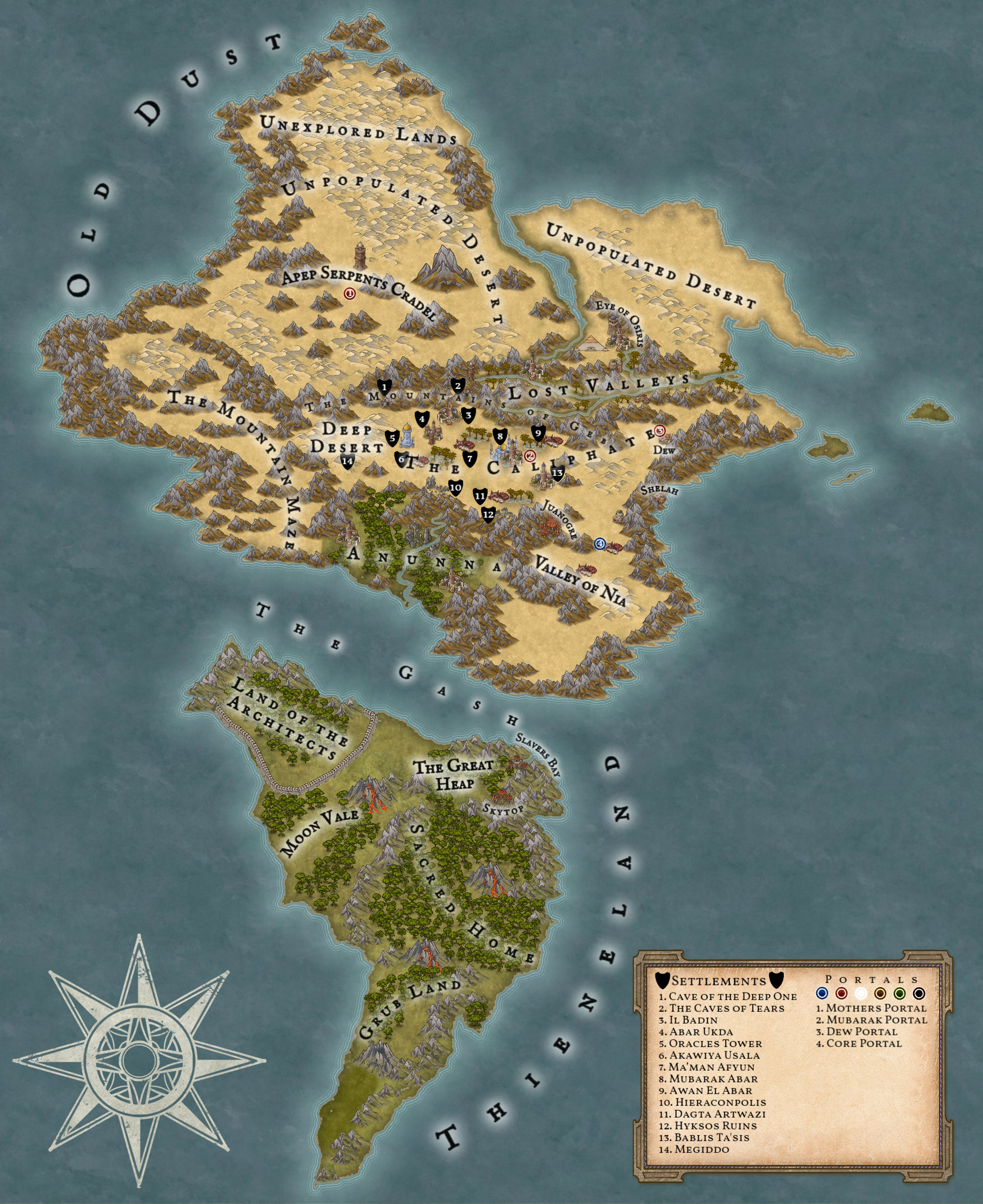
In the centre of the continent lies the Oasis of the Caliph once known as the Thousand Tears of Nia. South of this lies the lands of Juanogre, home of the Ogres and further south still lies the Valley of Nia. To the north are the lands of the Serpents known as Apep and to the southwest the newly discovered lands of the Anunna and to the northeast across a mountain range are the Lost Valleys.
To the far south lies Thieneland. Once part of the main continent but damaged by events in AU19, this is now a separate land mass with its very northern edge a walled off region known as the home of the Architects of Iron.
Only the hardiest or most desperate would attempt to survive in the deepest deserts, where the sands, djinn and efreet combine to make travel extremely hazardous hampering any exploration effort.
Although the politics of the well known regions are fairly well established, that of the newly discovered area is, for the most part, unknown. Dust politics tends to monarchies and theocracies in stable areas. Smaller areas or nomadic bands tend to fall into more of a tribal structure.

The Caliphate
This area was once called the Thousand Tears of Nia indeed it is still called that by some. But this area was named after actions of the now dead god Arak and the Caliph wants Arak and memories of his legacy to be banished as a forgotten thing of the past.
The oasis was traditionally home to people suited to desert living, with the majority of the population living in towns clustered around oases such as Mubarak Abar. These areas offer little shelter from the burning sun during the day or the freezing desert nights.
Trade between settlements relied on caravans which slowly track across the ever shifting sands, following well established trade routes.
Here money is everything, slavery is the norm and theft is a legitimate business tactic – provided you don’t get caught. In this culture wealth should be displayed, as wealth opens doors and the deal is what matters.
The Temples and Shrines of the former Gods Arak & Nia have been stripped of their wealth by the band of cutthroats known as the Sable Veil and they now work to try to rule Oasis from the shadows.
The official ruler of the region is the Caliph. He remains in power despite the Sable Veil, theories abound about this. Some say he is their puppet, others that his is their leader, but maybe he just pays them enough to leave him alone. None truly know.
The Caliph’s power lies in his control of the Mentary, a group of academic mages that have developed their skills into technology that allows them to enslave elementals to do their bidding.
With the loss of Arak and recent wars, the old religions are rarely practised. The majority of people here follow the Gods of the Lost Valleys, although in truth, most follow the worship of wealth above all.
Noble Titles
- Caliph – The Leader of the Caliphate.
- Imperial Prince/Princess – Children of the Caliph.
- Sultan/Sultana – The Rulers of the City States of the Thousand Tears.
Etiquette, Laws, Traditions and Social Taboos of the Oasis of the Caliph
Women once had no standing in these lands and older or more conservative types may prefer it to still be thus. But with many wars and the rise of new gods, women now have equal status under the law.
The Church of Arak outlawed the use of black powder. While the Church is gone, it is still viewed as unclean and thus the ban remains.
Thieves have their hands cut off unless they are wealthy and can pay the Caliph. Murderers are beheaded unless they are wealthy and can pay the Caliph.
(The majority of people believe they are the chosen and thus their life has more value than any outsider’s. Effectively a weregild system is in place. If there are any deaths they can be assuaged by the payment of blood money. The price of a local is at least twice that of the noblest foreigner. If this is paid there is no beheading. Unless of course a foreigner is to be beheaded then it is the best entertainment to be had.)
The culture frowns upon the delivery of bad news. This develops into the approach of deliberate untruths about anything that might upset someone. It took one family a year to inform their father that their mother had died.
Business arrangements can be very interesting, as the buyer will inform all the sellers that he will buy from them. When in fact, he intends business with only one (to avoid saying no to and thus disappointing anyone). Even when the business deal has gone through it is bad form to tell the disappointed contacts. Better to tell them that it was someone else’s decision, or that they will get the deal next time.
Personal space is much closer for the people of Dust. Cultures from the other Shards consider them to be far too familiar. They are very tactile and often hold hands and put their arms around each other and their favoured guests. Their timekeeping is atrocious. They will demand that you abide by a definite time and place and then arrive hours late. They are too polite to say they have to leave.
Workers will agree that they understand you perfectly because to ask a question would cast doubt upon your choice of words.
Slavery is a common practice and is legal. Slaves fulfil many roles, house servants, labours, gladiators etc they have monetary value, only the Caliph can grant freedom to slave.
Politeness – People are generally polite to each other all the time, swearing of any kind is never well received.
Praise – Praising people for any reason in the most effusive manner possible is to gain their respect and if done exceptionally well will gain the admiration of those who overhear the praising.
Generosity – The giving of gifts is central to all the cultures of Dust and gifts are always offered for the smallest of reasons. People of other Shards often think of them as bribes. The people of the Oasis thinks of them as lubrication and an indication of respect. No powerful man would dream of dealing with a stranger without some monetary inducement carried out through a subordinate who also requires his dues.
It is always wise to remember though that on Dust every smile hides a desire, every gift hides a curse and every praise a hidden meaning.
Bad decisions are rarely challenged because that would question the judgement of the leader.
Wealth should be displayed as blatantly as possible as an indication of how much you are blessed by the gods.
Notable Settlements
Abar Ukda – Formerly the seat of power of the Magi until they were outlawed. Tall towers are all that can be seen from a distance. For non-Magi to enter Abar Ukda was often fatal, now the Caliph has declared the area off-limits.
Akawiya Usala – Situated roughly in the middle of the Thousand Tears, formerly a large temple complex where the Clerics of Arak studied the scriptures and passed down the laws. Now it is the stronghold of the Mentary.
Awan el Abar – Unclean members of society, such as lepers, are banished to the desert. Some of these outcasts have banded together to claim an oasis as their own.
Babili Ta’sis – The Babili are very independent as are many of the households of the Thousand Tears of Nia, standing as a testimony to stubbornness, when all the other nations went to war in a massive land grab during the first stages of the Rage of Arak, Babili refused to give up its homelands. Ultimately when their lands could no longer support them, most of the available land was occupied. Despite being a poor source of water, the descendents of Babili have made good use of their resources. Well known for their engineering and metal work, the Babili have fortified their estates and raised a small army.
Dagta Artuwazi – The well of nightmares is shunned by all who know it. Many a foolish traveller have stayed the night by its calm waters only to be driven mad by the ghosts and other spirits that dwell there. It is said that the ghosts of a slaughtered caravan haunt this place and constantly look for more souls they can “recruit” into their ranks to protect the precious oasis.
Il Badin – The majority of Oases in the Thousand Tears of Nia are small, family controlled affairs. Il Badin is a good example. Only one well provides water for the settlement. The family of Badin travel to other wells when their own runs down, as do many other families who lead a semi-nomadic lifestyle. Goats and camels are the main resource for such families.
Ma’man Afyun – Threats, bribes and powerful ‘Blades’ are all that prevents this dubious drug den from being cleared out. Illicit goods and services of all kinds can be found in its dark and narrow streets.
Mubarak Abar – The Capital of the Caliphate, with the Caliph’s palace here. Not so much an oasis as a cluster of many small oases around which has grown a large trading community. Merchant houses and coffee shops fill the Bazzars. Anything can be traded for here if the price is right. Once the Guilds of Whitewater had a large holding here, but they were expelled by the Caliph. The main Janissary barracks are also located here.
Other Locations
Basatin Badin – The garden in the desert. This is a lush and private estate near Mubarak Abar owned by the Caliph. The apparent misuse of water for cultivating flowers is widely frowned upon, but also demonstrates extreme wealth which solidifies the Caliph’s status.
Cave of the Deep One – One of the pins of the Spirit Worlds.
Hieraconpolis – Once a mighty city of an empire now known as Shibin el Kom. A haunted ruin that travellers take a wide route to avoid is all that remains. Legends of the desert attest to great treasures hidden there and many a bold tomb robber has disappeared searching them.
Hyksos – Far to the south of Shibin el Kom lie the ruins of Hyksos rule. Within a single year of the start of the Rage of Arak it became apparent to the Hyksos that their lands would no longer support them. After several years of military build up which included arming the general populous, the Hyksos invaded Shibin el Kom. Due to the wars against the M’Mubians, Shibin el Kom was unable to repel it sborders. The Hydsos subsequently occupied an area known as Lower Kemet. It was not until 880 years later that the Hydsos were finally driven out of Shibin el Kom. The remains of the Hyksos are said to wander the great deserts, still looking for a homeland.
Megiddo – Deep in the heart of the burning sands lies a small collection of standing stones. This is all that remains of an ancient city destroyed in a siege a thousand years before the Rage of Arak. The only beings to survive in this burning hellhole are the Djinns who gather around the stones and whisper secrets to the wind. As the only current information about this ruin is gained from the Djinn themselves it is liable to be grossly inaccurate.
Oracles Tower – Said to be paired with another Tower in the World, the Oracle was a mysterious seer. Her symbol was the peacock. She has not been seen in decades and is believed to be dead or has left the world. The tower has remained sealed.
Nomads
M’Mubians – The descendants of this ancient people live a subsistent life on the upper banks of Iteru (The river of Shibin el Kom). During the Rage of Arak the armies of M’Mubia swept into Shibin el Kom. Their forces were eventually crushed but at great cost to Shibin el Kom. In retribution, many M’Mubians were put to the sword. The survivors scratch a living and are mostly ignored by their neighbours.
Janissary Corps
With Elementals enslaved within the Caliphate, many part elemental children are taken by the Caliph’s people. They are indoctrinated and formed into the Caliph’s elite soldiers and form much of his household troops. Thus, the Janissaries are a standing force directly loyal to the Caliph, forbidden to marry, own land, or swear allegiance to any line except the imperial one.
They are slaves, but not in the ordinary sense. They are “slaves of the state”, forbidden to leave service yet elevated above common citizens in prestige. Their privileges and strict hierarchy separate them from the wider population. Society envies, despises and fears them. Yet the people have also come to rely on the Janissaries as the ultimate guarantors of the Caliph’s rule and the empire’s safety.
The Caliphate runs ‘academies’, which function simultaneously as barracks and prisons. Instruction follows three intertwined tracks:
- Conditioning: Repeated recitation of the doctrine that elementals owe their lives to the Caliph. The children are taught that their powers are “borrowed” and must be surrendered back to the state. Rhythmic chanting, ritualised discipline, and symbolic purification, twist their minds toward obedience.
- Martial Training: Years of drilling, the young Janissaries learn sword, spear, bow, elemental projection, and formation tactics. Elemental talents are incorporated early, and each cohort develops its own martial culture.
- Academic Education: The Janissaries are some of the most literate subjects in the Caliphate. They study administration, mathematics, history, scripture, and practical engineering. It is said they must “think as the Caliph commands”.
Elemental traits determine Corps Branche:
- Dima’ Alnaar Corps: Fire-blooded soldiers shaped into shock infantry.
- Dima’ Alard Corps: Earth-blooded soldiers, heavy infantry and siege specialists.
- Dima’ Alhawa Corps: Air-blooded soldiers, used as scouts, messengers, skirmishers, and elite archers.
- Dima’ Alma Corps: Water-blooded soldiers, amphibious troops, many also find duty in the Royal water holes.
The Mentary
A group of academic magic users that have the technology to enslave elementals. Formerly a branch of the Magi, the Mentary are based in Akawiya Usala. They are a group dedicated to using the magical resources of Dust to enslave the elements and Djin into machines. They work directly for Caliph Khalil and are considered by many the future of Dust, believing they will bring prosperity and wealth. They are despised by other Magi who see them as ‘not true Magi’.
Notable People
- Caliph Khalil – The Leader of the Caliphate. Full title; Caliph Khalil, Sovereign of The Sublime House of Khalil, Sultan us-Selatin (Sultan of Sultans), Padishah of the Thousand Tears, Sultan of Mubarak Abar, Guardian of the Oracles Tower, Master of the Ocean Gate.
- Vizier Shihab Zaki – Head of Mentary, elemental enslavers working for the Caliph.
- Ignus – Mentary and Half Elemental working as a Slaver for Mentary.
Children of Nia
The Children of Nia, who reside in the valley of Nia, well protected by mountains and by its people. Within it the Nians live as nomads, tough survivors and trackers who move with the seasons. They look after the land, only taking what it is prepared to give. They seek a quiet life and love to tell stories around a warm fire in cold desert evenings. The Nians do not keep slaves, they hold no land as the land belongs to no one. People are the lands guests, and a guest takes only what the host is prepared to give. Owning land is an Arakite idea, Arak claims all, while Nia claims nothing. They have nothing and want nothing but the clothes they wear, the tents they live in and a few always useful trinkets.
Each camp is led by a council of its elders. The nearest thing to a priest is the Teller, who holds the camp’s stories, and the names of its dead. Finders, the most gifted at finding water, are held in an honoured place.
The Nians have always been a persecuted people, those that followed Arak tried to wipe them out. They spent many years fighting Arak’s faithful, and they now face dangers from the Cult of Arak, the Caliphate and more who despise their existence, but such has always been their lot. It is for that reason they have little trust of strangers, yet many people from other regions tell stories of how a Nian saved them from something. The Nians know what it is like to be called filth, be unwanted and have an inbuilt need to want to help others.
Until a Nian gets to know someone they will always hide their face by wearing the turban desert style with the end of the cloth wrapped over the lower part of the face so you can only see their eyes. They are allies to the Efreet and Magi, and they follow the Goddess Nia. It is this religion that shapes much of their rituals and practices.
The Children dress to conserve waters and no culture anywhere in the world is more skilled at getting the best out of the land and finding water than the Nians. Water is sacred to them, and every cup is finished to the last drop. Spilling water carelessly is a sin and can earn the death penalty; spilling it deliberately in a Nian camp is certain death. To share water with someone is the deepest bond a Nian can offer.
They know how to weave a material that is cooling in the heat and warming in the cold nights. They have developed ways to filter waste for precious water, screens to collect condensation and enchantments on face coverings that can even collect the water vapour in their breath.
It is said the Nians hide the secret of a pass leading to a much more verdant land.
The Lost Valleys
The Lost Valleys are a recently discovered set of regions with dry, arid and stony lands between the mountain ranges, but these Valleys have rivers that provide lush fertile land on their banks. The people are well fed and generally happy, freedom however does not exist, they live in fear of the Gods displeasure, and send their children to built great monuments.
The culture and costume of this region mostly resembles ancient Egypt
Structure
- Hat-a-Mun – The region is ruled by Hat-a-Mun a cruel, unkind heartless pharaoh, she rules, her word is law and if she dislikes you, you will die.
- High Priests – Below her are her family who are all High Priests or Priestess of one of the Gods of lost valleys. These High Priests/Priestess have total freedom to do as they please and are above the law and command in her name.
- Priests – Below the High Priests are other Priests, minor family relations or other favored people, they travel, may carry weapons and can gives orders to those below them that don’t countermand orders given by those higher, they live, die and receive their wealth at whims of the High Priests/Priestess
- Marked Ones – Below the Priest sit the Marked Ones – Mostly scribes and other skilled crafts people or perhaps merchants, they have no authority but may travel freely. They may carry weapons for personal protection.
- Military – Alongside the Marked ones sit the army, slaves conditioned to follow instructions without thought, they carry weapons, they are so conditioned that they will kill themselves without argument on command for the Gods have willed it.
- Shaduf/Slaves – At the bottom sits rest the people The Shaduf, they are for all intents and purposes slaves they Gods says they must obey the priests or the rivers will run dry, the land turn to dust, their children will die, they will all die of disease. The Shaduf either toil building great monuments to Hat-u-mun and the gods, toil in fertile land providing food or other items. Unless chosen/given in tribute to build great monuments or become part of military they never leave their own village.
Bastet
Among the Lost Valleys are the Bastet, a species of Cat Beastkin that follow the Lost Valleys God Bast, they are rebels among the people, but are left alone by High Priests in wild areas of the land for reasons unknown. The Basted dress in a similar style to the rest of Lost Valley although they will more wild and may be dressed in rags, furs and other animal skins.
Notable People
- Hat-a-mun – Pharaoh of the Lost Valleys
Juanogre
Juanogre is the home of Ogres. It has formed around an Oasis between two mountain ranges which protect its southern, western and northern borders.
Juanogre is a principality of the Oasis of Caliph, its ultimate sovereign is the Caliph. Its dress and style are very much similar to this land but is run by a King with a more forward thinking agenda. King Langstrom, leader of Ogres, does not believe in slavery. But otherwise much of the culture of the Oasis of Caliph exists within this land. Juanogre is tasked by the Caliph to guard the Great Portal and all Ogres consider it their sacred duty to do so.
The Ogres have within their number Magi who dislike the Caliphs love of the Mentary, who enslave elementals. Since Magi were termed rebels, the Magi in Juanogre are called the Gifted Ones when they are talked about and keep themselves well away from the eyes of Caliph.
The Ogres of Juanogre may follow the Gods of the Lost Valleys and Nia, although predominantly they follow the teachings of the Star Mother.
Notable People
- Langstrom – King of Juanorge
- Quelch – Ogre Magi
Anunna
This is newly discovered land, not much is yet known about it. Only the name has travelled with the nomads out of the new passes along with new trade goods.
Apep
Apep was discovered in AU13. Until AU19 it was only accessible by a hidden portal, but now with great upheaval to the land, passes have opened up meaning it is now accessible.
This is home to a species of humanoid sized and shaped serpents, peaceful ones, unusual since most other known serpent species seem to hate humanity and other species.
The Apep culture has developed in line with guidance from their God, the Star Mother and a long war with a species of Cat people that have since left the region.
Little more can be said so far about them.
Thieneland
Thieneland is a land with a mix of jungles and savanna. It is one of the newly discovered lands first found by ships around AU8 and is relatively unexplored apart from its coastline.
The region near the southern coast has been raided by Salem, Dust and Thunders for slaves which are easily acquired as the region is very primitive, disorganised and most of the people found there are easily influenced.
A chief of the region is called “Skywalker” but none have met them. They are said to rule from an area to the south of a mountainous region called Skytop although without roads or any apparent army their rule is suspect at best.
The natives call themselves the Cloud People and are roughly fifty percent Humans and the rest are best described as Goblins, but these are not anything like the Goblins that can be found in Faerie, they have ancestral knowledge of machines, even though the region apparently has none and so they are much prized by slavers for capture.
They follow the 5 Gods of The Cradle.
Slavers Bay
Nestled in a valley with only a narrow pass inland and a bay protected by jagged rocks, Slavers Bay is a settlement that has grown from years of slaver ships raiding the coast of Thieneland. Predominantly dominated by Slave Traders from Dust, though with many from Thunders and Salem, it has become a hub for Slaver activity. There is no formal government, only the power of coin rules this town.
Notable People
- Sky-Walker – A Leader in Thieneland
Architects of Iron Enclave
To the North of the Thieneland region is a large area that is walled off. The wall is ancient and its gates well protected by magic. The Cloud people call this the home of great Architects, the home of Iron and Steam and a place you do not go.
Other groups, organisations and individuals
- The Sable Veil – The Sable Veil are a gang of cutthroats and thieves, said to rule the Caliphate.
- The Hashashin – A group of assassins said to be insane from drugs.
- The Shadow Bandits – A small warband, they can be found in the Fortress of Shadows.
- Amira – Leader of the Shadow Bandits.
- Dagwa – Djinn who owes about 6 players a favour.
- Omar – Slave working for Totty building a brewers house in Mcuen lands
- Father Hawk – Originally an archivist. Reader of the actual Wissen, powerful in True Faith
- Nadia Karymeh – Vyrnnu creation who owns the city of brass and has domain over all scarabs.
The Magi
These are powerful sorcerers and summoners of demons and Djinn. It is hard to tell if this is an actual group as there is often more than one person claiming to be the leader. Despite this and an often-fragmented hierarchy, the Magi are often quick to support each other in the face of external threats to themselves.
Needless to say, the summoning of demons and Djinn makes them a feared group. If it were not for their immense power and policy of attack one Magi, attack us all, they would probably have been wiped out centuries ago.
Magi used to often be found working for caravans or at oases where they summon protection for an exorbitant fee, however those times have gone. In April 15 AU, the Magi declared the Mentary were no longer Magi and promptly the two groups declared war on each other. In response the Caliph declared the Magi to be Outlaws in the land of Dust.
The Cult of Arak
There is no god but God.
This is the core doctrine of the Clerics of Arak, and every Child of Arak must recite it. It is spoken on waking, before labour begins, and as the last words of the dying. To speak it facing the rising sun, before a Cleric, is to enter the faith.
For generations the Church of Arak was a power wherever its people lived. When the Shards came together in 0 AU, the power of Arak died, and the Church died with it. The Churches were pillaged and a new order rose over the lands. What survived hardened into the Cult. Its message is simple; God turned away because the World grew decadent and unfaithful, and he will look again only when it is made clean.
The Testament of Arak
The Clerics keep the history of the World in a single scripture, the Testament of Arak. It is recited in seven movements.
- The Lighting: The many gods, idle and decadent, command Arak to light the day and bring life to the World. He obeys, and for eons he looks down upon it.
- The Making: Displeased with the lazy creatures below, Arak remakes part of the World to his own design. His new people are hard working and pious, they are the Children of Arak.
- The Straying: His Children learn the bad habits of their neighbours and begin to worship other gods.
- The War in Heaven: Arak makes war on the gods. They are weak from their lazy lifestyle and he is strong from his daily routine. Stars fall from the sky or are knocked from their places.
- The Scorching: Arak burns the land in a holy purge so that only his own hard working people survive, and punishes his Children until they return to obedient worship. Never again will they be weak and lazy.
- The Weeping: Every god is banished from the heavens but one. Nia hides by day and comes out only while Arak sleeps, weeping for the fallen gods and their lost children. Her tears fall upon the earth and hold back his rage for one more day.
- The Time of the Faithful: The Faithful rule and toil in the name of Arak, those who defy him are cast down and the time will come of the second scorching that will finally burn all the unworthy away.
Teachings
Arak, the One
Arak is the sun, lord of light, life and labour. His virtue is his course, rising, crossing the sky and setting without fail or rest. Strength comes from routine, and holiness from strength; the gods fell because they were idle, and so too shall those who are idle before the sight of Arak.
The Chosen and the Unworthy
Arak remade only part of the World. Those he remade are the Chosen people, all others are the Unworthy, creatures of false gods. Purging the Unworthy is not cruelty in Arakite eyes. It is finishing God’s work.
The Clerics have never agreed on how to tell one from the other. Over the centuries the test has been faith, bloodline, custom and conduct, and it has widened whenever the Church needed an enemy.
Nia, the Thief of Night
Nia is the one god Arak could not find. Arakites call her the Weeper or the Thief of Night, and teach that her weeping is not grief but defiance. She is a coward who hides from judgement and steals the hours when God sleeps. The Testament is explicit; the faithful must seek out those who are not truly human and purge them, and the Children of Nia must suffer worst of all.
The Empty Sun
The sun still rises, but the Cult teaches that Arak no longer looks through it. When the Shards came together in 0 AU, his gaze left the World, too horrified by what his Children had come to. The sun since then is the sightless eye. Without his gaze the Lost Valleys were unsealed, the false gods stirred, and the Church fell. The Cult exists to bring the gaze back, and show Arak that his Children have not all turned from him. When he returns, that day shall be the Second Scorching, the Day Without Night, when the sun will not set and Nia will have nowhere left to hide, and the lands will be wiped clean once more.
Practices
The Church of Arak once kept a temple in every settlement. The Cult has no temples, but its members keep the old practices with more fervour than the Church ever demanded.
The Hours of the Sun
The faithful pray three times a day, following the sun’s course.
| Hour | When | Observance |
| Rising | First light | Face the sun, speak the Creed, Labour begins. |
| Height | Noon, when shadows are shortest | The holiest hour. Stand bareheaded in full sun, recite a movement of the Testament, and confess any idleness aloud. Nothing can hide when there is no shadow. |
| Setting | Sunset | Kneel facing the sun as it goes down, give thanks for the day’s work, and lay down tools. |
No prayer is said at night. The night belongs to Nia while Arak sleeps, and to pray then would be to pray into her ear.
The Day’s Work
Labour is worship. Every Child of Arak works each day from Rising to Setting, and Clerics labour alongside the faithful. There is no day of rest, because the sun takes none. Idleness is the first sin of the Testament and the root of all others; begging, gambling and long feasting are its children. Intoxication is forbidden for the same reason, because it makes the body weak and the hands idle.
The faithful sleep when Arak sleeps. To be abroad at night without need is suspicious, and to walk by moonlight is shameful. An Arakite who must work or travel after dark carries a lamp, called a borrowed sun, and keeps its light between them and the moon. The faithful will not look at the moon at all. Children are taught to cover their eyes when it rises.
The Days of Thirst
For the Longest Day, the faithful take no water from Rising to Setting. The fast remembers the Scorching and proves that Arak’s people are strong where others are weak.
Burning the Dead
The dead are burned, never buried, and the pyre is lit at the Height so the smoke rises straight to the sun.
Holy Days
| Holy Day | When | Observance |
| The Longest Day | Midsummer | The faithful drink no water and labour from first light to last, speaking the Creed at the Height. |
| The Longest Night | Midwinter | Nia’s strongest night, and the one night the faithful do not sleep. Fires burn in every yard until dawn so that her tears fall on hot ground and vanish. |
| Sunsdark | Whenever the moon covers the sun | The great blasphemy; Nia blinding God. The faithful beat drums, shout the Creed and light every fire they own until the sun returns. |
Faithful of Nia
The faithful of Nia have no church, no temples and no written scripture. Their faith is the Keeping; the keeping of water, of memory, of one another, and of the goddess’s secrets. The most numerous group of faithful are the Children of Nia, and their ways have shaped this religion.
The Promise
All who follow Nia will find water when their need is greatest, that is the promise of Nia.
Every camp holds stories of the Promise; a spring beneath a stone no one had turned before, a dead well running for a single night, a stranger appearing over the dunes with a full waterskin. Nians say Nia most often keeps her Promise through Nian hands. This is why no Nian refuses water to someone in true need.
Teachings
Nia, the Hidden
Nia is the goddess of the moon and the last of the old heavens. She survived the War in Heaven by hiding, and she hides still from the sun each day. Nians do not think hiding is cowardice. It is how the weak outlast the strong, and they have outlasted the strong in the same way.
The Tears
Each night Nia weeps for the lost, and her tears fall upon the earth as dew. That dew holds back Arak’s rage for one more day. To Nians it is mercy made into water, gathering it is an act of worship, and the wasting of water is a sin.
The Compassion of Nia
Nia weeps for children who were never hers, Nians are taught to do the same. They know what it is to be called filth and unwanted, and they will not do that to another.
Arak
Nians do not deny that Arak is a god; they deny that he is the only one, or that he is just. They fear him the way desert folk fear the noon sun, as a power to shelter from rather than to fight.
Practices
The Telling
The Nians have no set prayers, their worship is the stories told around a warm fire on cold desert evenings, in the water collected each dawn, in the faith in friends and family, in the stranger spared the persecution of others, in the lives that are lived.
The Moon Road
Each month the Nians move their herds to fresh pasture as the land and water decline. They move on the nights of the full moon, travelling by Nia’s light while Arak sleeps and resting in shade through the heat of the day. The people walk the Moon Road in silence until the new camp is pitched.
The Kindness of Nia
Nians help strangers but seldom give their names. A rescue is given veiled, no thanks is asked, and the rescuer does not linger. A Nian who has saved a stranger tells it only at the Telling.
All should be Free
Arak sought to bind every people to his will, and no Nian will own another person. A Nian who keeps a slave is cast out, and their name is struck from the Telling.
Rites
The First Walk
A young Nian comes of age by walking alone into the desert and returning with water they found themselves. No one may tell them where to look, and they may carry no water out. Those who return receive a water flask of their own. Those who do not return are said to have been found by Nia. Their names enter the Telling like any other.
Returning the Water
When a Nian dies, their water goes back to the land. The body is buried at night beneath the moon, at the roots of a living plant or with a seed sown above it. The grave is left unmarked, both to hide it from those who once desecrated Nian dead and because Nians claim no land, not even a grave’s width. The dead’s few possessions are shared among the camp. Their name is spoken at the next Telling and kept ever after.
Holy Nights
| Holy Night | When | Observance |
| The Full Moon | Monthly | The camp moves by Nia’s light. |
| The Dark Night | Monthly, at the new moon | Nia hides wholly. No fire larger than a lamp is lit, and the camp keeps vigil. |
| The Longest Night | Midwinter | Nia’s greatest night. The whole camp keeps the Telling until dawn and sets out every dew screen it owns. |
| Sunsdark | Whenever the moon covers the sun | The holiest sight a Nian can witness; Nia standing between Arak and the World. All work stops, and the camp falls silent until the sun returns. |
The Gods of the Cradle
- Spiker – The God of Metal – followers believe in learning, science and growth, they want freedom of information and end to wasteful wars.
- Junk – The God of Scrap – followers believe nothing should be thrown away, items, ideas, rubbish, sewage, use and re-use everything, collecting is a good thing
- Tapist – The God of Memory – followers are story tellers, law keepers, they want order, they want laws, they want records to be kept, .. monks of this order are the only people in this land able to read and write.
- Bester – The God of Win – followers believe in striving to be best, to be top of the bunch, they think war is good it thins out the weak, shove your enemy’s face in the mud and gloat, tell everyone how good you are they need to know. Fear nothing, laugh when friends die, its not sad its funny because its not you.
- B’Grain – The God of Feast – followers believe in tending the land, looking after others, they want the world to grow, have sex make babies, eat lots and fart, healers should be treated with respect. followers tend to be laid back and lazy.
The Star Mother
The Star Mother calls her people the Star Born and her guidance is that of freedom of will, everyone is free to make their own choices, they are not to be bound by anyone. The strong protect the weak and survival of all is key.
The Gods of the Lost Valleys
- Meretseger – Meretseger was known as the guardian of the ways , the doorkeeper to the spirit realms with the ability to move souls or to keep them locked away. Known to be reclusive and private by her very nature. Patron of all things that slither, and most Lizards.
- Bast – Bast, Goddess of the Home and patron of felines, prayed to by many homemakers to protect the home and goods within and also Patron of craftsmen
- Sekhmet – Sekhmet is a god of combat. Incredibly skilled with all things violent, is famous for her short temper. Daughter of a god who tricked her into drinking pomegranate wine (which she believed to be blood) after she had killed his champion in anger. Drunk on the wine/ blood when she returned to her father he quoted “Daughter, you have come back peaceful” and from then she was Transformed into Hathor – goddess of motherhood.
- Hathor – Goddess of motherhood, legend says that she was the drunken reincarnation of the war goddess Sekhmet.
- Geb – God of the earth. Created at the same time as Nut, the sky goddess, from the primordial chaos, they shared an incestual relationship (creating Kephri) before being banished to remain apart forever. Geb often looks up with longing at Nut, creating mountains in a vain attempt to reach her.
- Nut – God of the sky. Created at the same time as Geb, the earth god, from the primordial chaos, they shared an incestual relationship (creating Kephri) before being banished to remain apart forever. Nut is the mother of Kephri, the sun god, whom she swallows at sunset and gives birth too each morning.
- Kephri – Kephri is the son of Nut and Geb, a product of their incest. He is reborn every day at sunrise, pushing his way from his mother’s womb. His is the incarnation of the sun, carrying and protecting its light across the sky to be swallowed again by his mother in the evenings. Bes – Bes is a happy, jolly god of partying and patron of the Brewers, Artists and all those who need inspiration.
- Thoth – Thoth is the wisest of the gods and a powerful spellcaster, known abilities have included magical resurrection. He has often shown man the error of his ways and values intelligence above all else. Those who anger Thoth are likely to incur complex problems to solve or even suffer a lack of wisdom at a critical moment.
- Ma’at – Ma’at is the goddess of justice and truth, who uses a feather to judge souls passing to the afterlife.
- Anubis – Anubis guides the souls of the dead through the seven gates and the hall of judgement to the afterlife. Patron to the morticians.
- Amut – Amut is the goddess of Love and Beauty, who is known to be very wise and capable of great feats of magical healing. Despite being the wife to Osiris, she is known for her chasteness and purity.
- Osiris – Osiris is the Patron god of Kings and leaders, known for his abilities to keep people calm and creating unity. Over time he also became a patron to farmers when the river which united the upper and lower kingdom created fertile farming plots.

Below is a bit of information on the creatures and species of Dust, it is by no means complete or accurate. Players who choose to play a character with Dust origin can pick from Human, Ogre, Ogryn, Cat Beastkin, Thieneland Goblin, and Human Elemental. Any other species listed are for Dust background information.
HUMANS
Humans make up 95% of the population of Dust.
OGRES AND OGRYN
Ogres and Ogryn can be played by characters from Dust.
Ogres
Ogres are an ancient species of large humanoids. They are very strong, tough and a little slow thinking, but should not be classed as dumb as they will get there eventually. Otherwise they are very human-like. They do not mix well with Humans and have their own region called Juanogre.
Ogryn
Ogryn are basically like Ogres, but Ogres and Ogryn dislike each other.
The Ogryn are a Bloodline species , they are different to Ogres in they have 2 small horns on their forehead. The Ogryn can be much dumber but sometimes stronger than Ogres. The bloodline is hidden at birth, you start Human, your Ogryn side only comes out later in life. You physically change, although the change is gradual, you slowly take on the attributes of the Ogryn, the stronger you get the dumber you get.
Ogryn have no fixed abode, they tend to work for the Sable Veil and other criminals, their strength is a useful tool and their slow minds makes them easy to manipulate.
Playing Ogre/Ogryn
Anyone wishing to play an Ogre or Ogryn must take the talents Potency and Fortitude, otherwise they are free to chose any ability a Human can pick.
When playing an Ogre in particular, players should wear costumes to bulk themselves up, they are meant to be large and muscular. Ogryn can get away with less while they are still changing from basic Human to Ogryn. New Ogryn should have 2 red circles on their forehead to represent the horns that are growing, these should be replaced later with 2 small horns.
THIENELAND GOBLINS
Thieneland Goblins are a species apart from anything you would normally expect of Goblins. They are smart, have an affinity with machines and a desire to collect things.
Thieneland Goblins still have green tinged skin, players wishing to play this species can choose this as their Racial Heritage. They are found mainly in Thieneland, although some may be found as slaves in workshops around the world.
HUMAN ELEMENTALS
Human elementals are creatures that are part human and part elemental. They are part of the 4 elements, Earth, Air, Water and Fire, players can choose Elemental as their Racial Heritage.
Human Elementals look Human and blend in with the population, they may come from any of the regions of Dust.
THE BASTET
Players wishing to play a Bastet or Cat Beastkin should choose appropriate skills from the Beastkin Heritage.
Bastet are generally warriors, tribal, few have any learning, some may be priests and all follow the Lost Valley’s God Bast.
Non-Playable Species
MUMMIES
Mummies are powerful undead, important powerful beings raised from the dead, sometimes wrapped in bandages, they are intelligent and can command other undead and raise armies of skeletons.
DJINN
The Djinn or Genies are creature of magic, they have no masters but capture one and they will grant wishes within their magical limits. Every time a Djinn uses their magic to grant a wish they give away part of themselves so they do so only when the need is great or they are bound to do so. The Djinn spend most of their time playing small tricks on people, they can turn to vapour and disappear, they can shrink and fly and unless bound to someone or something are generally harmless.
EFREET
The Efreet are the dust name for the larger elementals, those that are large enough to be intelligent, fire, earth, air and water, although most efreet you will encounter in Dust are fire, while water ones are very rare.
APEP
The Apep are a human size and shaped intelligent reptilian species also known as Serpent people. They are strong and wise, one Serpent warrior can fight ten Human warriors and win. They should not be confused with Sutekh or Saurons, their numbers are small, they cannot mimic Humans nor do they have acidic blood.

Dust Pre-history, Arak’s Rage
It is said a thousand years ago there were several world-spanning cultures living on Dust, for it was a verdant place. A place of lush jungles and steaming swamps more akin to the shard of Frontier. Then the night skies changed and the shard became locked in an eternal summer. Within a generation most of the shard had been changed beyond recognition. Entire civilisations were destroyed and the very earth was scorched.
This time has become known as Arak’s Rage.
Once a fertile land, it was scorched dry and turned into a desolate arid waste under the God Arak’s unrelenting insane fury. After this, Dust was a dry and sun blasted land. Boasting sand aplenty, with arid mountain ranges poking through the deserts and a few clusters of oases, holding the precious water of life.
Before Arak’s Rage the area now known as the Caliphate, or the Thousand Tears of Nia, was supposedly a swamp. Neighbouring nations flocked to this area as their own lands began to dry out. The mighty swamp also dried out but left behind many small oases. It was around these oases that the Survivors clustered and fought hundreds of skirmishes to protect their claims. Dozens of cultures combined into the society we see today.
The Church of Arak spread across the lands and only those who were faithful were spared its wrath.
Dust Modern History
After the Shards fused to form the new world, Arak departed. With Arak gone, his temples were sacked and his wealth redistributed to those strong enough to hold it. A political storm driven by commerce washed over the populated towns found clustered around the oases.
New lands have been found as mountain passes opened up, where once only a portal could get you to Dust, now ships have found its coast. Along with lands, new political struggles are starting. Dust’s culture is much in flux, the return of lost religions and the spreading of new ones create even more complications.
Most of what has come to be known as ‘Old Dust’ is dominated now by the Caliphate, ruled by the Caliph
AU 13 – 14 (1828 – 1829),
A Magi called Al-Fulani came to prominence, feared by the other Magi he acquired a vast estate which ran from the Oracles Tower in the west of Dust out into the Deep Desert. Survivors from settlements he had acquired say that the inhabitants were killed or captured and then Al-Fulani’s men appeared to be digging in the sands as if looking for something. However, towards the end of AU 14 the great evil magi Al-Fulani was killed.
AU 15 – 27 (1830 – 1842),
The Caliphate developed institutionalised Slavery, promoted wealth as a means to power, expelled all Magi except the enslavers of the Mentary who build machines to enslave elementals, and formed enslaved half-elemental children, turning them into the indoctrinated soldiers of the Janissary Corps.
AU28 (1843), August – The Guilds are expelled from Mubarak Abar, the Caliphate seizes control of all portals in their territory and threaten Juanogre to hand over control of the Blue Portal.
AU29 (1844), May – The Caliphate is threatening war on the Ogres if they do not surrender the Core Portal of Dust. The bulk of the Caliphate army remains in Mubarak Abar. A Strange Worm creature is beneath the sands of the Dew Portal. Caliphate forces were attacked at the Dew portal and the Caliph has vowed there will be retribution.